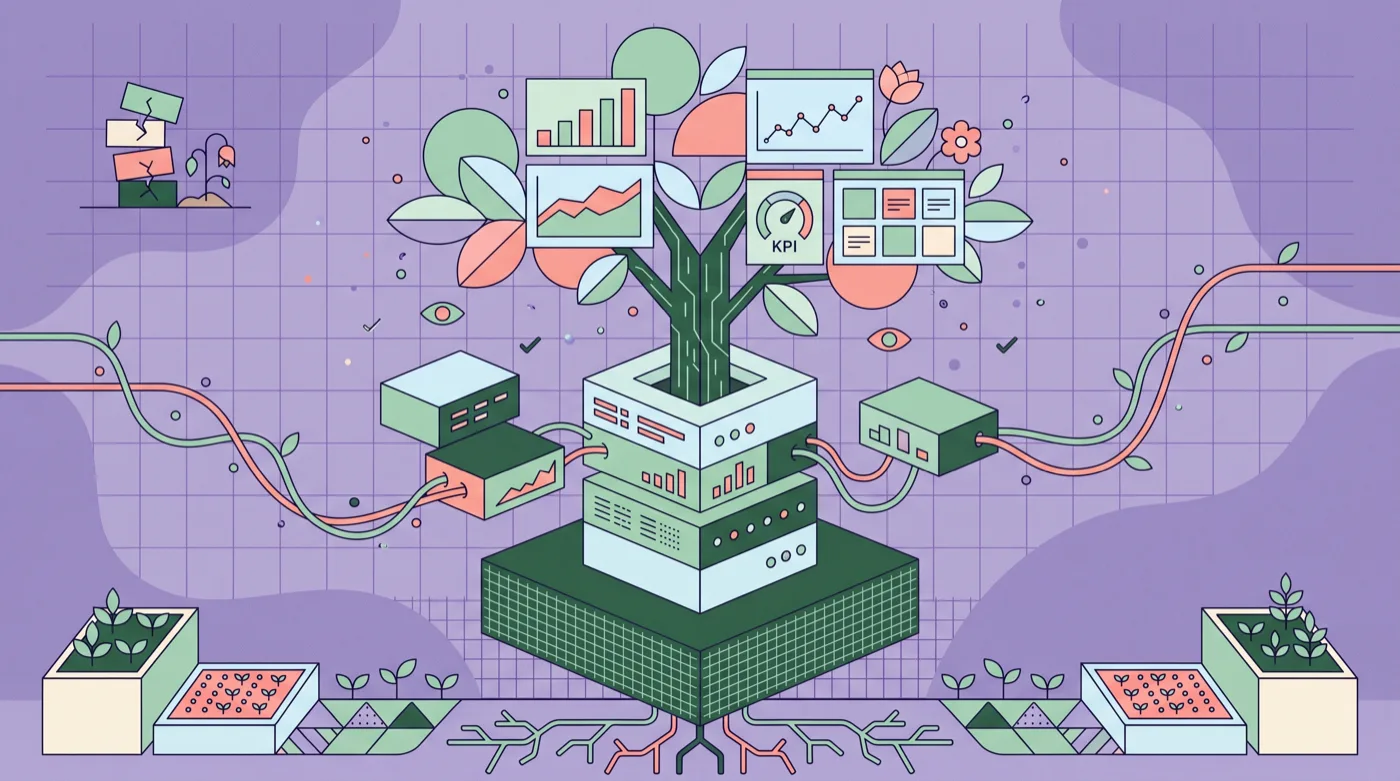
The terms "scalable" and "robust" come up frequently in conversations about Business Intelligence. But what do they actually mean in practice – and how do you know whether your current BI solution can grow with your business?
The terms "scalable" and "robust" come up frequently in conversations about Business Intelligence. But what do they actually mean in practice – and how do you know whether your current BI solution can grow with your business? This guide explains what scalability means, why it matters, and offers five practical questions you can ask about your own platform today.
A scalable BI solution can handle increased load, more data, more users and more requirements – without needing to be rebuilt from scratch.
Put simply, a scalable solution works just as well when the organisation is small as when it has grown. It keeps pace with the business instead of holding it back.
For a BI system, scalability means that:
When a BI solution is not scalable, it often leads to technical debt, long development cycles, duplicated work and poor data quality – costs that rarely show up in the initial investment, but become clear within a couple of years.
Business Intelligence constantly needs to adapt. New business areas, processes, goals, data sources, legal requirements and users all affect the BI platform on an ongoing basis.
A BI system that is not built for scalability risks becoming:
Scalability is therefore not a "luxury" or a technical detail. It is a prerequisite for BI to work as a long-term investment rather than a recurring expense.
Here are five practical questions you can ask internally to assess whether your BI platform is built for the future:
A scalable data model has clear layers and structures (for example, a medallion architecture) that can accommodate expansion without disrupting the core.
If a minor adjustment to a KPI or metric causes unexpected side effects in several places, the solution is not scalable – it is fragile.
Without these, the BI system depends on individuals. When a key person leaves, the understanding of the logic walks out of the door with them.
Scalability relies on order and control – not on Excel logic, improvised solutions or hidden calculations in individual reports.
A well-built BI architecture should handle considerably larger datasets without compromising performance.
If the answer is "no" or "do not know" to several of these questions, you probably have scalability debt to address – and it is better to discover it now than after the next major data source or regulatory change.
A company often starts with a specific reporting need. With the right foundation, it can gradually connect more departments, KPIs and reports without the model falling apart. What began as one report grows organically into an ecosystem that the whole business relies on.
A scalable solution means that when invoicing doubles, the customer base grows or the distribution network expands, the system continues to deliver accurate insights without bottlenecks. Management can continue to make decisions on the same data-driven basis throughout a growth phase.
Regulatory changes are one of the clearest tests of scalability. A scalable BI platform can accommodate new data types, classifications and reporting requirements – such as CSRD, the EU Taxonomy or the GHG Protocol – without requiring a complete rebuild.
A scalable BI solution is rarely the cheapest to build – but it is almost always the cheapest to own. It provides:
That is why BI projects without scalability often become considerably more expensive over time: they have to be rebuilt. Every rebuild costs money, time and trust in the data.
Understanding what a "scalable BI solution" actually means is a crucial part of every organisation's BI strategy. It is not a technical detail buried deep in the architecture – it is about building a data environment that can grow with the business rather than work against it.
Scalability is not a quality you can easily add afterwards. It is built in from the start, or rebuilt at considerable expense later.
